Omega-3 LC-PUFA may improve certain aspects of sleep health throughout childhood. Additional robust studies are warranted to confirm the relationship between omega-3 LC-PUFA and sleep.

pubmed.ncbi.nlm.nih.gov
Omega-3 long-chain polyunsaturated fatty acid and sleep: a systematic review and meta-analysis of randomized controlled trials and longitudinal studies
Results: Omega-3 LC-PUFA may improve infants' sleep organization and maturity. It reduced the percentage of infants' active sleep (WMD = -8.40%; 95%CI, -14.50 to -2.29), sleep-wake transition (WMD = -1.15%; 95%CI, -2.09 to -0.20), and enhanced the percentage of wakefulness (WMD = 9.06%; 95%CI, 1.53-16.59) but had no effect on quiet sleep. Omega-3 reduced children's total sleep disturbance score for those with clinical-level sleep problems (WMD = -1.81; 95%CI, -3.38 to -0.23) but had no effect on healthy children's total sleep duration, sleep latency, or sleep efficiency. No effectiveness was found in adults' total sleep duration, sleep latency, sleep efficiency, sleep quality, or insomnia severity.
Conclusion: Omega-3 LC-PUFA may improve certain aspects of sleep health throughout childhood. Additional robust studies are warranted to confirm the relationship between omega-3 LC-PUFA and sleep.
Emerging evidence suggests that adequate intake of omega-3 polyunsaturated fatty acids (n-3 PUFAs), which include docosahexaenoic acid (DHA) and eicosapentaenoic acid (EPA), might be associated with better sleep quality. N-3 PUFAs, which must be acquired from dietary sources, are typically...

www.mdpi.com
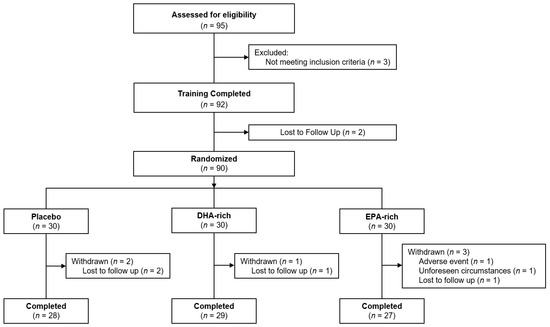
Emerging evidence suggests that adequate intake of omega-3 polyunsaturated fatty acids (n-3 PUFAs), which include docosahexaenoic acid (DHA) and eicosapentaenoic acid (EPA), might be associated with better sleep quality. N-3 PUFAs, which must be acquired from dietary sources, are typically consumed at suboptimal levels in Western diets. Therefore, the current placebo-controlled, double-blind, randomized trial, investigated the effects of an oil rich in either DHA or EPA on sleep quality in healthy adults who habitually consumed low amounts of oily fish. Eighty-four participants aged 25–49 years completed the 26-week intervention trial. Compared to placebo, improvements in actigraphy sleep efficiency (p = 0.030) and latency (p = 0.026) were observed following the DHA-rich oil. However, these participants also reported feeling less energetic compared to the placebo (p = 0.041), and less rested (p = 0.017), and there was a trend towards feeling less ready to perform (p = 0.075) than those given EPA-rich oil. A trend towards improved sleep efficiency was identified in the EPA-rich group compared to placebo (p = 0.087), along with a significant decrease in both total time in bed (p = 0.032) and total sleep time (p = 0.019) compared to the DHA-rich oil. No significant effects of either treatment were identified for urinary excretion of the major melatonin metabolite 6-sulfatoxymelatonin. This study was the first to demonstrate some positive effects of dietary supplementation with n-3 PUFAs in healthy adult normal sleepers, and provides novel evidence showing the differential effects of n-3 PUFA supplements rich in either DHA or EPA. Further investigation into the mechanisms underpinning these observations including the effects of n-3 PUFAs on sleep architecture are required.
Differential Effects of DHA- and EPA-Rich Oils on Sleep in Healthy Young Adults: A Randomized Controlled Trial