Linkki on rikki, mutta tässä korjattuna:
https://verdelehti.fi/2022/06/22/yl...o-etta-ruotsin-koronapolitiikka-oli-toimivaa/
Artikkelissa viitataan vahvasti Lancetin artikkeliin, jossa johtopäätöksissä on mielenkiintoinen havainto.
Efforts to improve pandemic preparedness and response for the next pandemic might benefit from greater investment in risk communication and community engagement strategies to boost the confidence that individuals have in public health guidance. Our results suggest that increasing health...
www.thelancet.com
"High levels of government and interpersonal trust, as well as less government corruption, were also associated with higher COVID-19 vaccine coverage among middle-income and high-income countries where vaccine availability was more widespread, and lower corruption was associated with greater reductions in mobility. If these modelled associations were to be causal, an increase in trust of governments such that all countries had societies that attained at least the amount of trust in government or interpersonal trust measured in Denmark, which is in the 75th percentile across these spectrums, might have reduced global infections by 12·9% (5·7–17·8) for government trust and 40·3% (24·3–51·4) for interpersonal trust."
Eli maissa joissa on korkeampi elintaso ja luotetaan enemmän yhteiskuntaan/viranomaisiin ja joissa on parempi rokotteiden saatavuus, voisi tartuntojen määrä olla globaalisti 12-9% pienempi. (huom. tämä ei liity kuolleisuuteen).
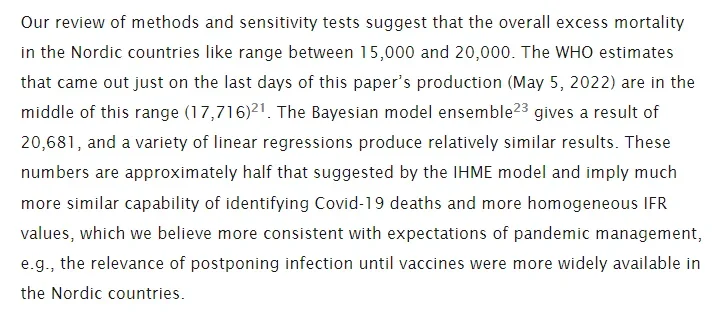
Sitten se paperi, johon Verdessä viitataan havaitsee, että Lancetin tutkimuksessaa perinteisellä tilastollisella mallilla ja datalla Suomen ja Tanskan kuolleisuuslukemat ovat liian isot verrattuna Ruotsiin ja Norjaan, jonka vuoksi dataa piti tarkastella eri tavalla ja "IHME" mallilla. Sen seurauksena Suomen ja Tanskan koronakuolemat eivät poikkea merkittävästi muista pohjoismaista ja asettuvat 20.000 koronakuolemaan tuntumaan normaalin kuolleisuuden päälle.
"Our review of methods and sensitivity tests suggest that the overall excess mortality in the Nordic countries like range between 15,000 and 20,000. The WHO estimates that came out just on the last days of this paper’s production (May 5, 2022) are in the middle of this range (17,716)21. The Bayesian model ensemble23 gives a result of 20,681, and a variety of linear regressions produce relatively similar results."
Kiitos artikkelista, sillä sen takaa löytyi mielenkiintoiset paperit.




:watermark(https://img.ilcdn.fi/vJKtqKt-3Oe2eHdIZRioxHwlUiA=/1200x0/https://assets.ilcdn.fi/6ea585db0aee3a99e6abb5bf4ab28fa702c6dab0b4b5cd7b810a251951acbe0d.png,0,-0,0)/img-s3.ilcdn.fi/46d3f84ab3c5e7c558a655380e8d0eea350d4551ae79a37482a9106460e0eccb.jpg)

/img-s3.ilcdn.fi/c28aa438f1f00534727b261cae8c6cf8e7d985acb2720bfec49eb6beb5c21394.jpg)

 ", "meilläkin menee juhannus karanteenissa nyyh". Vittuako tekevät noita testejä, iso osa ei ilman niitä edes tietäisi olevansa "kipeä". Toisaalta tuntuu että nimenomaan haluavat saada pos. tuloksen niin pääsevät laittamaan tikusta kuvan someen, keräämään säälipisteitä sekä tuntemaan kuuluvansa laumaan. Nämäkin ovat niitä hyödyllisiä idiootteja.