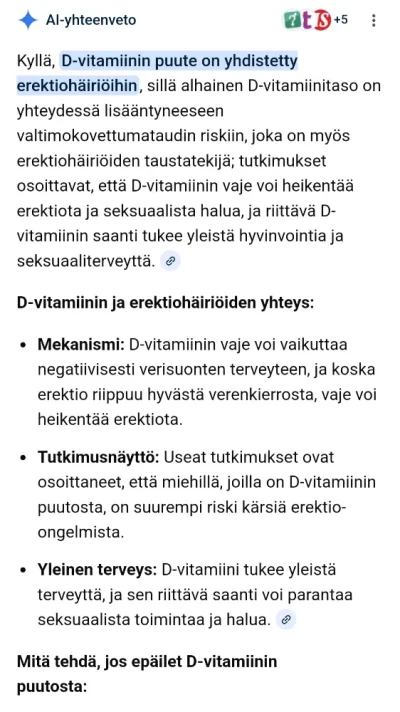
Pistetään d vitamiiniaiheinenki. ;)
Viikko sitten julkastu;
Preclinical studies show that vitamin D plays a key role in muscle regeneration and immune modulation. Some trials suggest a U-shaped relationship between 25-hydroxyvitamin D [25(OH)D] concentrations and fall risk. Optimal 25(OH)D concentrations for minimizing fall risk may range between 20 and 40 ng/mL, with risks increasing at both lower and higher concentrations. Results of clinical trials with vitamin D supplementation on muscle performance and fall prevention in older adults are not conclusive.
•
There is a curvilinear relationship between low vitamin 25(OH)D concentrations and increased risk of cardiovascular diseases. In patients with heart failure or myocardial infarction, circulating 25(OH)D concentrations below 10 ng/mL have been associated with increased left ventricular end-diastolic and systolic diameters, ventricular dilatation, and worse clinical outcomes. Although randomized controlled trials show inconsistent results, some studies suggest that vitamin D supplementation may reduce adverse left ventricular remodeling and lower the incidence of atrial fibrillation, particularly in older adults or patients with heart failure and hypertension.
•
There are clear inverse correlations between vitamin D status and insulin resistance, the risk of diabetes, and chronic diabetic complications. Vitamin D supplementation improves blood glucose, reduces the progression to diabetes, and increases the likelihood of regression to normal glucose regulation in adults with prediabetes, though optimal dosing strategies, are yet be investigated.
•
Obesity is inversely related to vitamin D status, with higher adiposity linked to lower vitamin D, and weight loss increases vitamin D concentrations. Obesity may cause low vitamin D due to dilution in larger body mass, storage of vitamin D in adipose tissue, and decreased activity of CYP2R1. This results in a reduced increase in 25(OH)D concentrations following supplementation which in turn may explain its still unclear role in obesity.
•
Future studies, also based on national and international registries, on the effect of vitamin D supplementation on cardiometabolic outcomes using individualized approaches —tailored to baseline vitamin 25(OH)D concentrations, patient risk factors, and comorbidities— and focusing on vitamin D-deficient populations will be helpful in better defining optimal regimens and fully exploring the clinical potential of vitamin D supplementation on cardiometabolic health as well as other extra-skeletal endpoints.
Consensus statement on vitamin D role in metabolic health